A2P 10DLC Verification for GoHighLevel
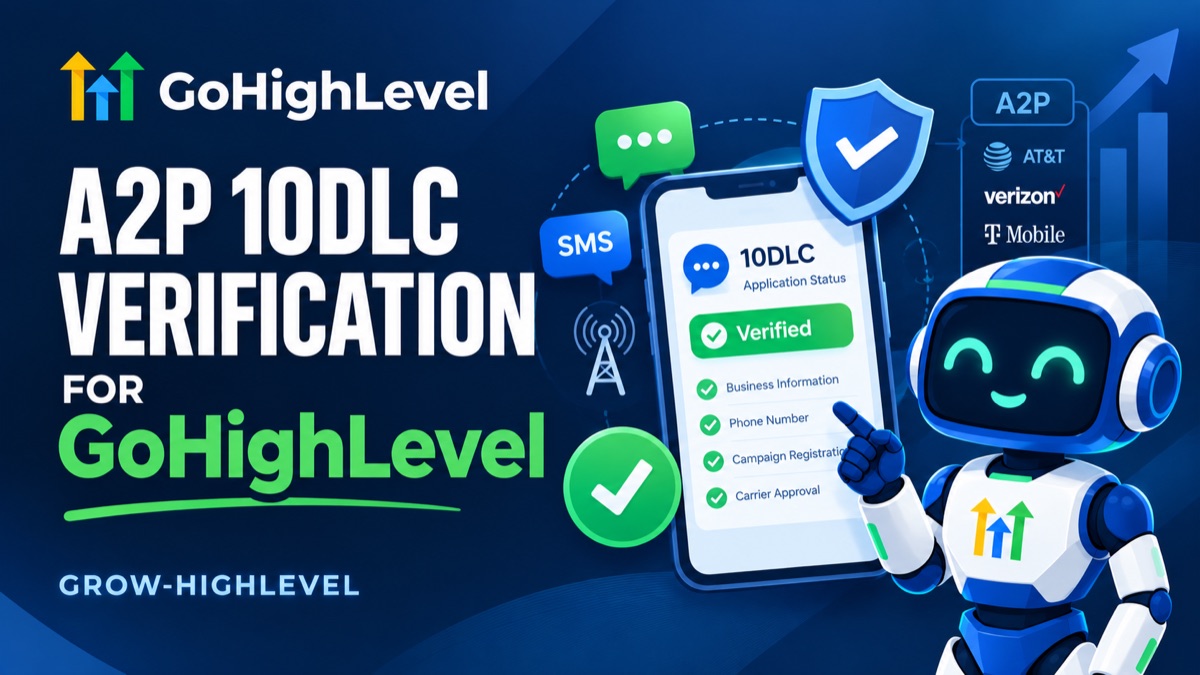
A2P 10DLC verification is the single most common technical blocker we see on new GoHighLevel accounts, and it's one most agency owners have never heard of until their texts stop going through. This guide covers what A2P 10DLC actually is, why carriers require it, the exact registration steps inside GoHighLevel, and what to do when a registration gets rejected. If you're setting up SMS on a new account, treat this as a step-zero task, not something to circle back to later.
What A2P 10DLC Is and Why Carriers Require It
A2P 10DLC stands for Application-to-Person messaging on 10-Digit Long Code numbers, the standard local phone numbers used for texting. Carriers introduced it because that same 10-digit format used to be exploited heavily for spam and unwanted marketing texts, sent from regular-looking phone numbers with zero registration or accountability behind them. A2P 10DLC creates a registered, traceable link between a business and the numbers it sends from. Carriers use that registration to decide how much trust, and how much message throughput, to extend to your traffic.
In practice, this means every business sending SMS through GoHighLevel needs to register a Brand (your business entity) and at least one Campaign (the type of messaging you'll send, like appointment reminders or marketing promotions) before carriers will reliably deliver those messages. This isn't a GoHighLevel-specific requirement. It's an industry-wide carrier mandate that applies to any platform sending business SMS in the US, GoHighLevel included.
What Happens If You Skip Registration
Unregistered SMS traffic doesn't just risk getting flagged, it gets actively filtered and often blocked outright by carriers. Messages either never arrive, or they arrive with meaningfully delayed delivery, both of which look identical to a broken automation from the client's side. This is one of the most common causes of the how-do-I-know-if-workflows-are-actually-working question we get from new clients, and it's rarely the workflow itself. It's an SMS registration gap upstream of it. Skipping registration to save a few days of setup time almost always costs far more time later, once you're troubleshooting phantom message failures across an account that's already live with real leads flowing through it.
How A2P 10DLC Registration Works Inside GoHighLevel
- Navigate to Settings then Phone Numbers then Trust Center inside your GoHighLevel sub-account or agency account
- Register your Brand first: legal business name, EIN or tax ID, business address, and website. This information needs to match your official business registration exactly, since mismatches are the single biggest cause of rejection
- Select the correct entity type (sole proprietor, LLC, corporation, nonprofit) since this affects both registration cost and the volume limits your Brand is approved for
- Register a Campaign under that Brand, choosing the correct use case: low-volume mixed, standard, or a specific vertical like real estate or financial services. The use case you select determines your message throughput and how strictly carriers screen your content
- Write sample messages that accurately represent what you'll actually send. Carriers review this content, and generic or misleading samples are a common rejection cause
- Submit for review, then link your GoHighLevel phone numbers to the approved Campaign once it clears, so they inherit the registration's trust and throughput
- Confirm delivery with a real test message sent to a phone on a different carrier than the one you tested with internally, since carrier-specific filtering can behave differently across networks
Common Rejection Reasons and How to Fix Them
- Business information mismatch: your registered EIN, legal name, or address doesn't exactly match official records. Fix by pulling the exact legal details from your incorporation documents, not from memory
- Vague or missing sample messages: carriers reject Campaigns where they can't tell what you're actually going to send. Fix by writing 2-3 realistic examples of your actual message copy, not placeholder text
- Wrong use case selected: choosing low-volume mixed for what's actually a marketing-heavy campaign gets flagged once real traffic doesn't match the registered use case. Fix by registering for the use case that honestly reflects your message mix
- Website doesn't clearly represent the registered business: carriers check that a submitted website actually belongs to and describes the registered Brand. Fix by making sure the URL submitted is live, accurate, and matches the business name
- Missing opt-in language or consent documentation: some use cases require you to demonstrate how contacts consented to receive texts. Fix by having your opt-in process documented and ready before you submit, not scrambled together after a rejection
Choosing the Right Campaign Use Case
The use case you register under isn't a formality, it directly sets your daily message throughput and how strictly carriers scrutinize your content. Low-volume mixed suits accounts sending a modest number of transactional and conversational messages, appointment confirmations, one-off replies, and comes with correspondingly modest throughput limits. Standard covers general marketing and mixed-purpose messaging at higher volume. Specific verticals like real estate, financial services, and debt collection have their own registered use cases with tighter content rules, since those industries carry a documented history of higher spam and complaint rates. Registering under the wrong use case, even accidentally, tends to surface later as unexplained throttling once your real message volume outgrows what you actually registered for.
Trust Score and Why Registration Quality Matters Beyond Approval
Getting approved isn't the finish line. Carriers assign an ongoing trust score to registered Brands based on factors like business verification depth, complaint rates, and consistency between registered use case and actual sending behavior. A higher trust score generally means better deliverability and higher throughput over time, while a Brand that registers vaguely, sends inconsistently with its stated use case, or generates spam complaints can see throughput throttled even after initial approval. Treat registration as something to get right once, not something to rush through and forget. A Brand with clean, accurate information and consistent sending behavior tends to earn better standing than one that technically passed review but cut corners to get there.
How This Affects Agencies and White-Label Accounts
Agencies managing many client sub-accounts run into A2P 10DLC differently than a single business does. Each client is typically its own registered Brand, since carriers register against the actual legal business sending the messages, not against the agency managing the account on their behalf. That means registration is a per-client onboarding step, not a one-time setup you complete once for your whole book of business. Build it into your standard onboarding checklist and your snapshot deployment process so it never gets treated as optional or forgotten under the pressure of getting a new client live quickly. Agencies that skip this step for the sake of a faster-looking launch consistently end up doing the work anyway, just later, and after a client has already noticed their texts aren't landing.
Realistic Timelines
Brand registration typically clears within a few hours to a couple of business days once submitted correctly. Campaign registration usually takes a bit longer, commonly a few business days, though it can extend to a week or more during high-volume periods or if a resubmission is required after a rejection. Build these timelines into any new client's onboarding plan from the start. Promising a client full SMS automation on day one, before registration has actually cleared, sets an expectation that's outside your direct control to guarantee. It's far better to set the expectation correctly upfront than to explain a delay after the fact.
Common Questions About A2P 10DLC on GoHighLevel
Do I need to register separately for every sub-account?
Each distinct business entity generally needs its own Brand registration, since the registration is tied to a specific legal business, not to a GoHighLevel account structure. If you're managing sub-accounts for multiple separate client businesses, each one typically needs its own Brand and Campaign, not a single registration shared across all of them.
What happens if I add a new phone number after registration is approved?
A new number just needs to be linked to the already-approved Campaign, which is a quick step rather than a full new registration. It inherits the existing Campaign's trust and throughput immediately once linked correctly.
Does A2P 10DLC affect email deliverability too?
No, A2P 10DLC is specific to SMS on 10-digit long code numbers. Email deliverability is governed by entirely separate mechanisms, domain authentication, sender reputation, and content filtering, and needs its own attention rather than being covered by SMS registration.
Getting It Right the First Time
Most rejections we see come down to rushing the Brand information step or copy-pasting generic sample messages instead of writing ones that actually reflect the account's real use case. Slowing down on those two steps specifically saves a resubmission cycle almost every time. This is exactly the kind of setup detail that's easy to get wrong once and expensive to leave wrong indefinitely, since every automation and campaign you build afterward depends on SMS actually being deliverable.
If you'd rather have this handled correctly as part of a full account build, our GoHighLevel setup services include A2P 10DLC registration as standard, not an afterthought bolted on once something's already broken. It pairs naturally with a proper CRM setup and automation build, since none of that automation actually reaches anyone if the SMS layer underneath it isn't registered correctly. Book a discovery call if you want it built right from day one.
If you would rather have someone take this off your plate, you can book a GoHighLevel consultant. See GoHighLevel pricing for fixed-price entry offers from $197.
Related Guides
Ready to Build This Inside Your Own Account?
We've helped 200+ agencies set up, automate, and scale their GoHighLevel accounts, without the trial and error. Whether you need the full build done for you or a specialist placed directly on your team, we can help.