GoHighLevel vs. HubSpot (2026 Comparison)
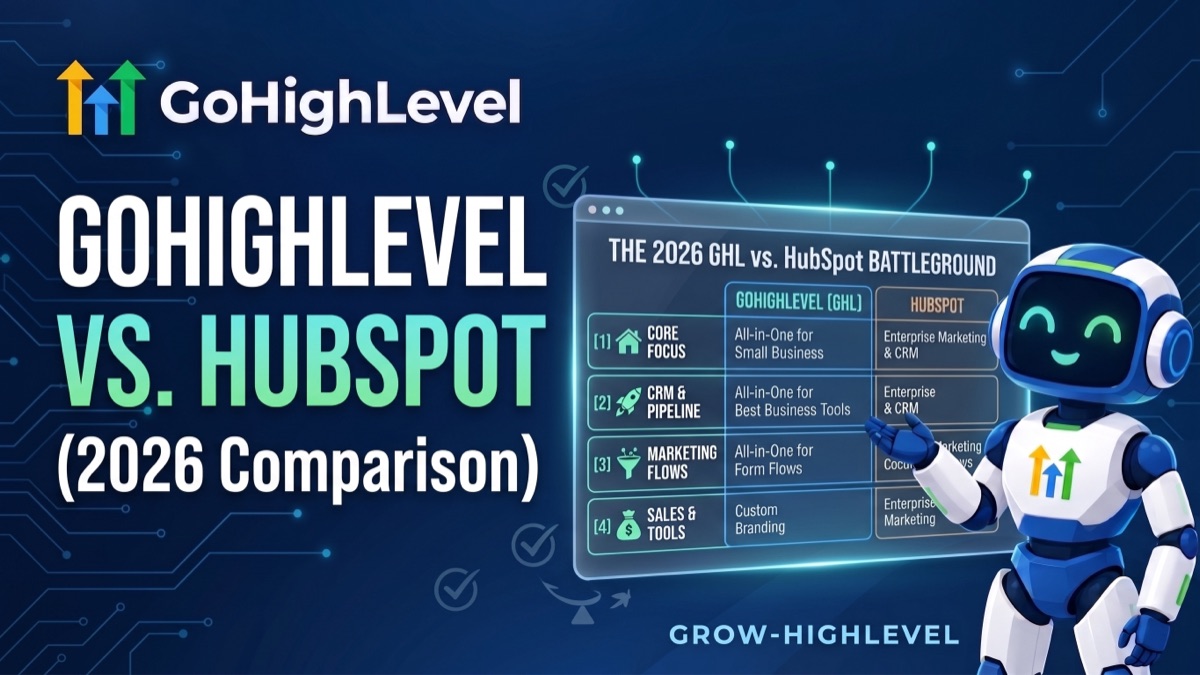
GoHighLevel and HubSpot both get pitched as the answer to the same problem: too many disconnected tools running your marketing and sales. That's about where the similarity ends. They're built for genuinely different buyers, priced on genuinely different models, and good at genuinely different things. This comparison walks through the areas that actually matter when you're choosing between them, especially if you're an agency deciding what to build client systems on.
Pricing Model: Flat Platform Fee vs. Contact-Based Tiers
GoHighLevel prices on a flat platform fee regardless of how many contacts you store or how many sub-accounts you're running underneath it. Its tiers run roughly $97/month for a single business, $297/month for unlimited sub-accounts, and $497/month for full white-label SaaS mode. Add contacts, add clients, and the platform fee itself doesn't move. Usage costs for SMS and email scale separately, but the core subscription is a flat number you can plan around.
HubSpot works differently. It's genuinely modular, with separate Hubs for marketing, sales, service, and content, each sold on its own tier, and pricing that scales with both seat count and contact volume. HubSpot does offer a real free CRM tier, which GoHighLevel doesn't have an equivalent to. But as you add Hubs, seats, and contacts, the cost curve climbs steeply, and it's common for a growing team running multiple Hubs to land well into four figures a month. For a single business with a small, static contact list, that free-to-cheap entry point is a real advantage. For an agency serving many clients, the per-client math tends to favor GoHighLevel's flat-fee structure by a wide margin.
All-in-One Platform vs. Modular Hubs
GoHighLevel was built from day one as a single platform: CRM, funnels, calendars, SMS, email, and automation all share one data layer natively. There's no integration step between features because they were never separate products to begin with. HubSpot took the opposite path. It grew from a marketing tool into a suite of separate Hubs that now share a contact database but were built and priced as distinct products. They integrate well with each other since HubSpot owns all of them, but you're still buying and configuring separate modules rather than one unified system.
In practice, this means GoHighLevel tends to feel more consistent end to end, since every feature was designed against the same contact record from the start. HubSpot's individual Hubs are often more feature-rich in isolation, particularly Marketing Hub's content tools and Service Hub's ticketing, but that depth comes from years of building each Hub as its own product line.
Agency and Multi-Client Support
This is where the two platforms diverge most sharply for agency use. GoHighLevel was built around sub-accounts from the ground up: unlimited client accounts, agency-level branding, and full SaaS mode that lets you resell the platform under your own name with automated billing. Managing dozens of clients from a single agency login is the platform's core use case, not an add-on.
HubSpot's agency support exists, but it's structured more as a partner program layered on top of a platform built primarily for single businesses to run their own marketing. There's no native equivalent to GoHighLevel's sub-account model or white-label SaaS resale. Agencies typically manage each client's HubSpot instance as its own separate purchase rather than spinning up sub-accounts under one umbrella. If reselling the platform itself is part of your business model, this difference alone tends to settle the decision.
Funnel and Landing Page Building
GoHighLevel includes a native drag-and-drop funnel and website builder, with hosting included, so you can launch a landing page or a full multi-step funnel without leaving the platform or paying for separate hosting. It's built specifically for conversion-focused pages: opt-ins, webinar registrations, order bumps, upsell flows. HubSpot's page and website tools are capable, particularly for content-heavy sites and blogs, and integrate cleanly with its CMS Hub. But funnel-specific features like order bumps and multi-step checkout flows are less of a native focus, and a genuinely conversion-optimized funnel build often leans more heavily on GoHighLevel's purpose-built tools.
Learning Curve
GoHighLevel's learning curve is real. It packs a lot of surface area, CRM, funnels, automation, conversations, into one interface, and a new user can feel overwhelmed in the first week without guided onboarding. Once the mental model clicks, most users move quickly, especially with a structured setup guide rather than exploring at random. HubSpot's individual Hubs are generally easier to pick up one at a time, since each is a more focused product. But that ease compounds differently once you're managing several Hubs together and stitching workflows across them, which introduces its own kind of complexity.
Reporting and Analytics
HubSpot's reporting is a genuine strength, particularly on higher tiers: custom dashboards, attribution reporting, and detailed campaign analytics that reflect years of investment specifically in that layer of the product. Marketing teams that live in reporting daily often find HubSpot's tools more polished out of the box. GoHighLevel's reporting has improved steadily but still trails HubSpot's depth in pure analytics sophistication, particularly for multi-touch attribution across long sales cycles. Where GoHighLevel pulls ahead again is agency-level reporting across many clients at once, since a single dashboard view across dozens of sub-accounts isn't something HubSpot's per-instance model was built to do natively.
Head-to-Head Comparison
| Category | GoHighLevel | HubSpot |
|---|---|---|
| Pricing structure | Flat platform fee, unlimited sub-accounts on top tiers | Per-seat and per-contact tiers across separate Hubs |
| Free tier | No permanent free plan, full-featured trial only | Genuinely free CRM tier for small contact lists |
| Best for | Agencies managing multiple client accounts | A single business consolidating marketing and sales |
| Funnel building | Native, purpose-built for conversion funnels | Capable, more content/CMS-oriented |
| White-label resale | Built-in via SaaS mode | No native equivalent |
| SMS and calling | Native, built into the core platform | Available but less central to the platform |
Integrations and Ecosystem
HubSpot has a mature app marketplace and a long history as a marketing-ops standard, which means most external tools, from accounting software to ad platforms, already have a polished native integration. If your business already runs on a stack HubSpot connects to cleanly, that maturity is a real advantage. GoHighLevel's ecosystem is younger but growing quickly, and it leans on a different strength: a genuinely open API and native webhook support that make custom integrations, the kind an agency builds once and reuses across many client accounts, more accessible without needing a marketplace app to already exist. Tools like n8n and Zapier connect to both platforms, so the gap matters most when you need something purpose-built rather than a generic connector. We cover GoHighLevel's side of this in detail in our API guide if custom integration work is part of your evaluation.
Customer Support Experience
HubSpot's support scales with your plan tier, and higher tiers unlock faster response times, phone support, and a dedicated customer success contact. On lower tiers, support tends to be primarily self-serve, leaning on HubSpot's genuinely extensive documentation and academy content. GoHighLevel's support is available across its plans without the same tier-gating, though as with any fast-growing platform, response depth varies by how the ticket is routed. For agencies specifically, this is exactly the gap that fulfillment and support partners exist to close. Instead of depending entirely on either company's support queue for day-to-day account issues, an agency-side team that knows the account handles most of it directly.
Which Platform Actually Fits Best
If you're a single business with a modest contact list and you want best-in-class content and inbound marketing tools, HubSpot's free-to-mid tier is a genuinely strong starting point. If you're an agency serving multiple clients, the calculus changes fast: sub-account management, white-label resale, and a flat fee that doesn't multiply per client all matter more than any single feature comparison. That's the exact scenario GoHighLevel was designed around, and it's why most agencies we work with land there rather than trying to make HubSpot's single-business model stretch across many clients.
Common Questions About GoHighLevel vs. HubSpot
Can I migrate from HubSpot to GoHighLevel without losing my data?
Contacts, notes, and deal history can generally be exported from HubSpot and imported into GoHighLevel, though custom properties and complex workflow logic typically need to be rebuilt rather than transferred automatically. Budget real time for this if you're migrating an established account, not just a fresh signup.
Is GoHighLevel a good HubSpot alternative for a single business, not an agency?
It can be, particularly if SMS and funnel building matter to how you sell. But a single business with a small contact list and no reselling ambitions may find HubSpot's free CRM tier genuinely sufficient, which makes the comparison closer for that specific case than it is for agencies.
Do agencies ever run both platforms at once?
Occasionally, usually when a client came in already invested in HubSpot and switching isn't worth the disruption. It's uncommon as a deliberate long-term strategy, since maintaining fluency and integrations across two full platforms doubles the operational overhead for comparatively little benefit.
If you've already decided GoHighLevel is the right platform and want it built correctly the first time, from pipelines through automation, our GoHighLevel implementation services handle the entire build. Book a discovery call if you'd rather talk through your specific setup than guess your way through it.
If you would rather have someone take this off your plate, you can book a GoHighLevel consultant. Our pricing page lays out the $197 audit and the $497 sprint.
Related Guides
Ready to Build This Inside Your Own Account?
We've helped 200+ agencies set up, automate, and scale their GoHighLevel accounts, without the trial and error. Whether you need the full build done for you or a specialist placed directly on your team, we can help.